
On Tuesday, March 2, 2021, Dr. Seuss Enterprises announced the following on their website:
Dr. Seuss Enterprises, working with a panel of experts, including educators, reviewed our catalog of titles and made the decision last year to cease publication and licensing of the following titles: “And to Think That I Saw It on Mulberry Street,” “If I Ran the Zoo,” “McElligot’s Pool,” “On Beyond Zebra!,” “Scrambled Eggs Super!,” and “The Cat’s Quizzer.” These books portray people in ways that are hurtful and wrong.
Speaking to The Associated Press, the company further elaborated:
Ceasing sales of these books is only part of our commitment and our broader plan to ensure Dr. Seuss Enterprises’ catalog represents and supports all communities and families. […] [We] listened and took feedback from our audiences including teachers, academics and specialists in the field as part of our review process. We then worked with a panel of experts, including educators, to review our catalog of titles.
Almost immediately after the announcement was made, sales of these and other Dr. Seuss books skyrocketed on sites like Amazon and eBay. In response, a spokesperson from eBay told The Wall Street Journal that they were working to prevent the resale of the six titles that had been discontinued. One eBay seller who had recently listed two of the titles for sale, shared an email she received from the auction site, stating the listings had been removed from sale due to violation of eBay’s “offensive material policy.”
Conservative-leaning circles decried the “cancel culture” behind the decision to halt publication of the six books. Tucker Carlson of Fox News said that the decision would “have consequences that extend for generations” and “if we lose this battle, America is lost.”
Breitbart ran a piece titled “Blue State Blues: Oh, the Books You Will Burn!”:
So Uncle Joe plotted
to get back at Trump.
The new “cancel culture”
gave license to dump.He called his advisers
and said, “I’ve no use
for fun-loving authors
like this ‘Dr. Seuss.’“Cancel the stories
that people enjoy;
shun those who say
that a girl’s not a boy.“Everything’s racist!
That’s what we’ll say.
Neanderthal Trumpsters
will soon go away.”
So, are these sentiments accurate? Has cancel culture gone too far and ruined a beloved children’s author?
My take? Well, not really.
Let’s take a look at these questionable books
The first thing I wondered when I saw the news was…what exactly is wrong with the books? Can you show me? I want to know exactly what kind of offensive material we’re talking about here.
Dr. Seuss Enterprises didn’t provide a handy illustrated guide or anything, so it’s hard to say the exact problem elements without flipping through the books themselves. After doing some research, here’s what I found as the likely issues:
And to Think That I Saw It on Mulberry Street, 1937
The synopsis of the story according to Wikipedia:
Marco watches the sight and sounds of people and vehicles traveling along Mulberry Street and dreams up an elaborate story to tell to his father at the end of his walk. The first book written, created and originated by Dr. Seuss.
Most of the book is pretty tame and nothing I saw as offensive.
Then, toward the end of the book, we’re presented with…

Oof.
While I’m not 100% sure if “Chinaman” was considered an ethnic slur in 1937, it definitely is one now. This character’s coloration is also a problem. Yes, Dr. Seuss illustrations tend to use unrealistic color choices. But when every other person in the book has skin color that matches the white of the page and this single Chinese guy has bright yellow skin…that feels unrealistic in a really offensive way. His exaggerated slanted eyes are also widely seen as racist today. I guess the Asian conical hat isn’t inherently racist…it’s something many farmers in China wear/wore. So I guess we can let that slide, though it still feels stereotypical.
The queue hairstyle (the long ponytail) is something I feel like I might be uneducated about. From what I can glean, it was once common for Chinese men to have this hairstyle, but I don’t know exactly when it stopped being common. So I feel like that part should be OK, but maybe I’m mistaken. I have similar thoughts on the sandals: I feel like they should be OK, but maybe there’s something I’m missing.
Also, Chinese people may use chopsticks, but this feels like perpetuating a stereotype that it’s the only way Chinese people eat.
So yeah, pretty problematic character.
Interestingly, this character had already been edited not just once, but twice since it’s original publication. In 1964 they apparently changed the text to “Chinese boy,” and in 1984, they altered his image and the text became “Chinese man.” (And did a poor job keeping the lines intact.)

My personal opinion is that the 1937 and 1964 versions are pretty bad and shouldn’t be appearing in modern children’s books. But honestly, the 1984 version seems…fairly innocuous? Like, I’d say fix the eyes and it would be a slightly outdated but acceptable depiction in my opinion. But I’m also a white person of European descent, so I know it’s not exactly my opinion that matters here.
McElligot’s Pool, 1947
The synopsis of the story according to Wikipedia:
A boy named Marco is ridiculed for fishing in a small, polluted pool, and tries to justify himself by imagining the fish he might catch.
There’s a page spread about halfway through this book that’s likely the cause for the “ban.”

The first issue in this page is the use of “Eskimo.” At the time of publication, this may have been considered acceptable. But the word “Eskimo” is no longer used or accepted by most native people of Canada and Alaska, as the term was imposed by colonialists. In general, the term “Inuit” has become the accepted term for these people. So could the use of “Eskimo” on this page be replaced with “Inuit” and everything would be good?
Well, there are other problematic elements. One is the igloo-type building in the background. My understanding is that while Inuit people did widely have dome-shaped houses made of hard snow in the past, it’s not really something commonly used today. So to show Inuit people living in igloos is like showing modern white Americans all living in log cabins ala Abe Lincoln. Like, it’s kind of a weird, outdated association that shouldn’t be so big of a thing. It makes it seem like Inuit people all live in the past.
There’s also the matter of the fur parkas being worn. Now, with my limited cultural knowledge of Inuit people, I don’t think it’s an issue for the human to be wearing such a parka. But maybe the fish wearing them could be seen as degrading? Honestly, this part isn’t as clear to me, so if anyone has more knowledge, please leave me a comment.
So yeah, even though “Eskimo” could theoretically become “Inuit” and the igloos could be digitally removed, I’m sure the fish wearing parkas makes this page impossible to fix without a full redesign.
If I Ran the Zoo, 1950
The synopsis of the story according to Wikipedia:
Gerald McGrew visits a zoo and finds that the animals are “not good enough” and describes how he would run the zoo. He would let all of the current animals free and find new, more bizarre and exotic ones.
This book…is VERY problematic. Here’s the first example I found:

“With helpers who all wear their eyes at a slant”!? I hope I don’t need to explain why that’s a problem. Not to mention the actual slant eyes in the illustration.
And why is this child making these poor “helpers” carry this cage on their heads? And these guys seem content about this? It’s all kind of messed up.
Next up…

Although this “chieftain” isn’t directly connected to any real-life people, he vaguely evokes the stereotypical look of some type of royal Arabian person with the fancy turban and clothes he’s wearing. Pair that with the text saying the kid will imprison the chieftain in the zoo and it becomes a pretty messed up page.
And now for the worst offender…

This is supposed to be from an “African island of Yerka.” While the text only directly references the bird, it’s pretty clear that the two other figures are supposed to be African people. The illustration is similar to the racist imagery used to depict Africans and Black people from around this time period. They basically look like apes with grass skirts on. It’s incredibly racist and wrong and has no reason to be in a children’s book. End of story. This image by itself is enough to make me agree this book doesn’t belong in the hands of children. We don’t need to dive any further into this one.
(Although there’s still more that’s problematic in the book:)
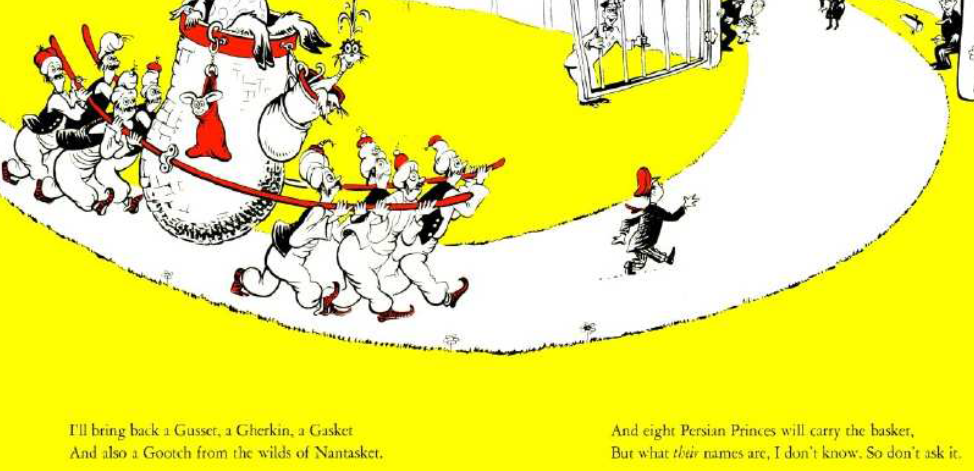
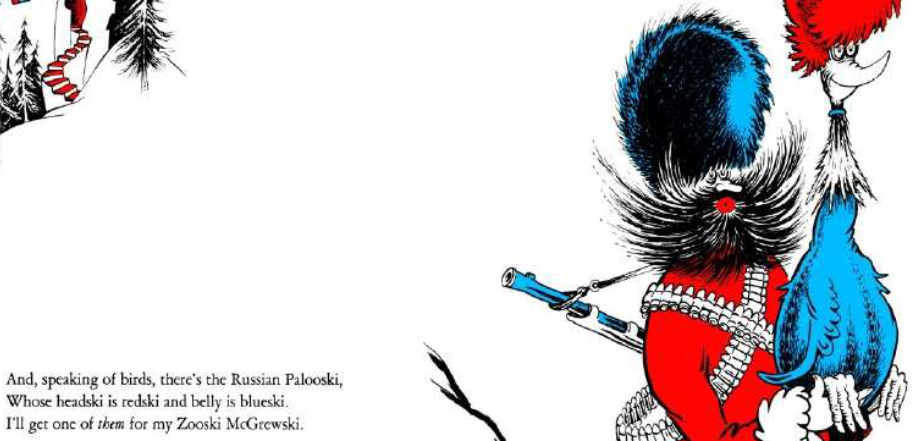
Scrambled Eggs Super!, 1953
The synopsis of the story according to Wikipedia:
A young boy named Peter T. Hooper spins a tale of an incredible meal he created by harvesting the eggs of fantastically exotic birds.
Starting pretty small with this one:
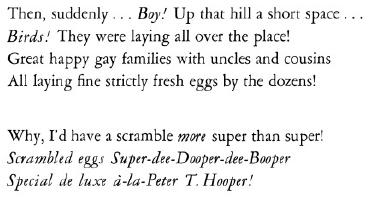
It’s not even offensive, it just uses the word “gay” in a way that doesn’t match modern usage. No big deal, but kind of begs to be updated. Unless all the birds are actually homosexual? I dunno.
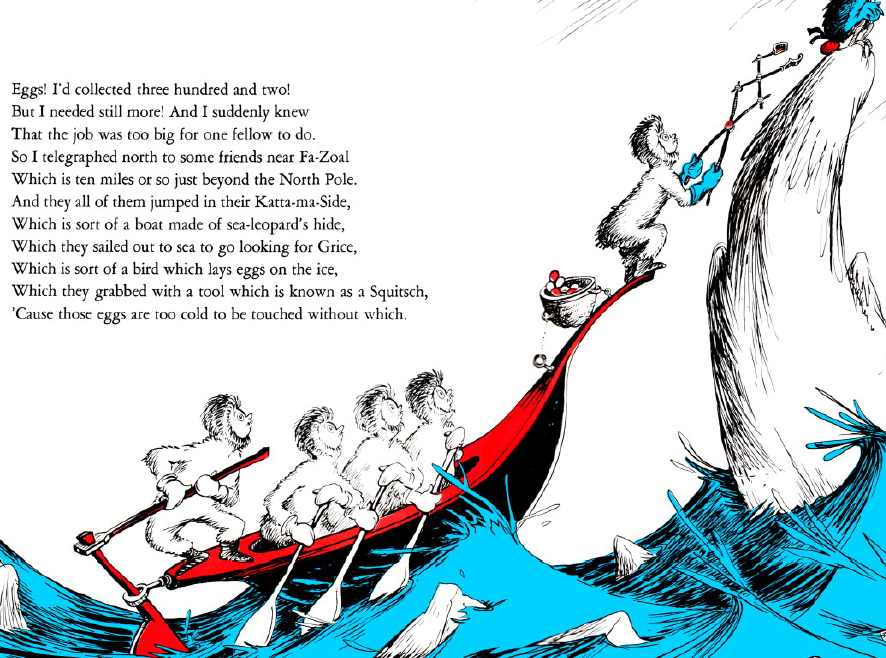
This is reminiscent of the “Eskimo” example earlier, but this time they’re never given a name of any sort and seem to be from a typical Seussian fictional location “near Fa-Zoal.” They’re all wearing fur parkas and they’re using a boat made out of sea-leopard’s hide, but I’m not sure if either of those things could be considered offensive? Again, not sure if I’m ignorant about something here, but this seems like it’s potentially OK?

Is this fellow named Ali offensive? I’m again feeling a bit out of the loop here. He’s about offensive as Disney’s Aladdin, isn’t he? Maybe it’s just because this seems like an outdated sort of depiction?
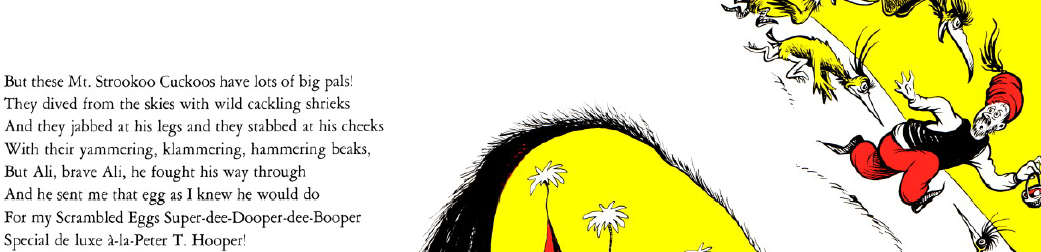
Same guy as the last example. Not seeing anything new here.
And…that’s it? Did I miss something here? This all feels fairly…benign. Is there something truly problematic here I’m glossing over? I’m sure they pulled this book for good reason, but I’m not entirely understanding what the reason is. (Hence why it’s wise to give these examples, so us ignorant people learn to recognize what kind of imagery/wording is harmful.)
On Beyond Zebra!, 1955
The synopsis of the story according to Wikipedia:
The young narrator, not content with the confines of the ordinary alphabet, invents additional letters beyond Z, with a fantastic creature corresponding to each new letter.
Starting with a pretty minor issue again:
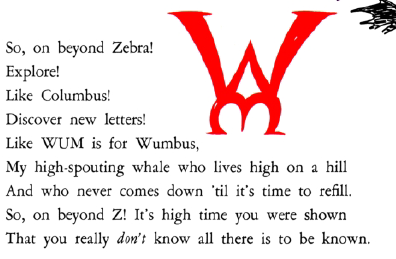
The mention of Columbus could be seen as problematic. Christopher Columbus has rightfully gone from being seen as a celebrated discoverer of America to someone who employed violence, slavery, and forced religious conversion on the American Indians. Not to mention how his crew spread Old World diseases, which led to the deaths of millions of people in the New World. This mention of Columbus doesn’t feel like a deal-breaker to me, but it’s certainly not great to see.

Here’s another problematic chunk of text. The Sneedle is similar to a mosquito, but it’s still discomforting to see text about killing/hunting anything in a children’s book. Then, the text starts mentioning “the bullet you shoot” and “old sour kerosene.” Not exactly kid-friendly language.

First off, “Spazz” is basically the word “spaz,” which is a very offensive word used to describe people with disabilities. It’s primarily offensive in the UK, but it still shouldn’t be used in American English.
Then we get to the imagery of this “Nazzim of Bazzim.” Again, it’s a person of fictional origin, but he’s still reminiscent of historical Arabian people. It could be seen as an outdated/stereotypical depiction. But I have little knowledge about the cultures of the Middle East, so I’m not sure how accurate my assessment is.
So yeah, On Beyond Zebra! isn’t the most offensive book on this list, but there are certainly problematic parts that might not be suitable for modern children.
The Cat’s Quizzer, 1976
The synopsis of the story according to Wikipedia:
The Cat in the Hat asks many, sometimes ridiculous, questions of the reader.
Most of this book is just filled with silly questions that don’t even amount to a story of any sorts. There are some problem spots, though…

Obviously, “to be a Japanese” is not only bad grammar, but this wording is commonly seen as offensive. Not to mention that it’s just a weird question to ask, even in this book filled with silly questions.
The answers page has a similar issue:

Also, this book just has a weird obsession with Japanese people:

Also, this next one’s nitpicky, but…
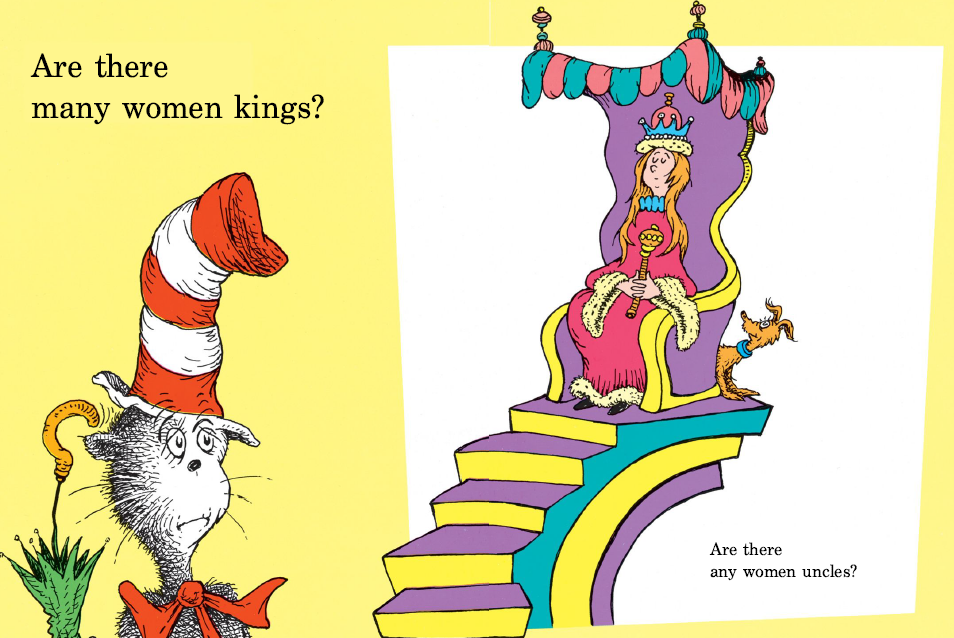

Technically, I know of at least one person who was considered a woman king, and that’s Jadwiga of Poland, who was crowned king in 1384. Again, a super nitpicky thing, but also a missed opportunity for an interesting fact.
Moving on — though I don’t have a great image for this next example:

“Pygmy” according to the Encyclopaedia Britanica means a “member of any human group whos adult males grow to less than 59 inches (150 cm) in average height.” And states that the “best-known Pygmy groups and those to whom the term is most commonly applied are the Pygmies of tropical Africa.”
Whether or not the term is offensive seems to be a topic of debate. At the very least, it seems to be widely considered outdated. And given that the illustrated figures are also colored to look dark, it feels like it’d be best to omit this question in general.
Was their solution the right conclusion?
At the very least, all of these books seem to have problematic/outdated references or illustrations. And there are some cases of explicitly racist content, most obviously in If I Ran the Zoo. In many cases, the offensive content would be difficult to edit/delete/replace without ruining the flow of a rhyme or story. Or it would require an entirely new illustration to be drawn, and it’s not like Dr. Seuss is still alive.
So, in general, I probably would agree with Dr. Seuss Enterprises’ decision to stop producing these books in order to have a catalog that “represents and supports all communities and families” (although I still feel Scrambled Eggs Super! didn’t really have anything wrong in it). And if the sales data showed that these weren’t selling much anyway, then it’s hard to fault their business strategy of pulling the books out of production.
Dr. Seuss Enterprises ceasing publication of these six titles doesn’t strike me as “cancel culture.” And it certainly wasn’t the work of any politicians (like Breitbart insinuated). Dr. Seuss Enterprises has an image they want to maintain and an audience they want to enjoy their books. If the company has books that go against their image and could offend their audience, it’s their right to stop producing them.
Speaking from a personal perspective, it does bother me somewhat to have these books no longer easily attainable. Especially with the actions of eBay. I believe collectors should still be able to acquire these books if they so wish. I don’t see the harm in that. As someone who can sometimes obsess over collecting things, it bothers me a lot that getting a complete set of Dr. Seuss books now seems impossible without being rich. But I’m also aware that I’m part of a niche group, and not part of the books’ primary audience.
Personally, I’d have rather seen the books pulled from children’s shelves, but still available in a limited capacity for adults to buy. I’d couple the books with the sorts of messages now shown before Looney Tunes/Merry Melodies cartoons and certain Disney movies, stating that the depictions were wrong then and wrong now, and that we should use these as learning opportunities. But, again, that’s just my preference for how to handle this. I’m not going to get up in arms over Dr. Seuss Enterprises ceasing production of books that most of us had never read and never had any intention of reading or buying.


 suspiciously generic
Seems reminiscent of Orwell’s “1984”, where everything has to be rewritten to match the current culture.